After thirty years in this business, the sentence I hear most from owners isn't "no." It's "that's never happened before."
It sounds like a reason. It isn't. It's a description of the past.
The past is data. It tells you what has been done. It can't tell you what can be done. Most of what we take for granted today was once something that had never happened before.
The ceiling sounds reasonable
Nobody says, "I've decided to stay small." The ceiling sounds like experience:
"Our customers won't pay more than that."
"Franchising is for companies with a corporate office."
"Technology is for chains, not a shop like mine."
Each of these is sometimes true. The danger is that once you believe it, you stop testing it. A belief you never test becomes a wall you never see.
Experts hit the same wall
In January, Daniel Litt, a math professor at the University of Toronto who follows AI closely, said the best AI models were at the level of math competition puzzles. Real research was still out of reach.
Four months later, an AI model proved wrong a belief the world's best mathematicians had held for 80 years. Top mathematicians checked the work. It held up.
He wasn't foolish. He described the past accurately. The future just moved faster than his description.
Nobody knows what this industry looks like five years from now. Not me, not the big distributors, not the delivery apps. That's not a reason for fear. It's an opening. When the map is being redrawn, the people who were "too small" last time get to draw part of it.
I watched it happen Sunday
On November 1, I stood on Fourth Avenue in Brooklyn and watched the New York City Marathon go by. Fifty years ago, this race left the loops of Central Park and ran through all five boroughs for the first time. That had never happened before either.
The elite women came through first, a tight pack under the light at 11th Street. Hellen Obiri, the defending champion. Sheila Chepkirui, who would win it. Jessica McClain, right in the middle. She finished second, the first American woman on that podium since 2018.
Then the men. Andreas Almgren of Sweden was tucked in the pack, running his first marathon ever. He won it in 2:06:01.
That's the headline. It isn't the real marathon.
The real marathon came after the elites were gone.
Marty Granoff came through with three generations of his family, his son and grandson running beside him. Their signs said: "I'm Marty and I'm 90. Cheer for me." Another said: "Slow and steady? More like 90 and iconic." The back of his shirt said: "If you can read this, you're losing to a 90-year-old man."
It was Marty's sixth New York City Marathon, and his first since 1983. He was one of two runners in their 90s in a field of nearly 60,000.
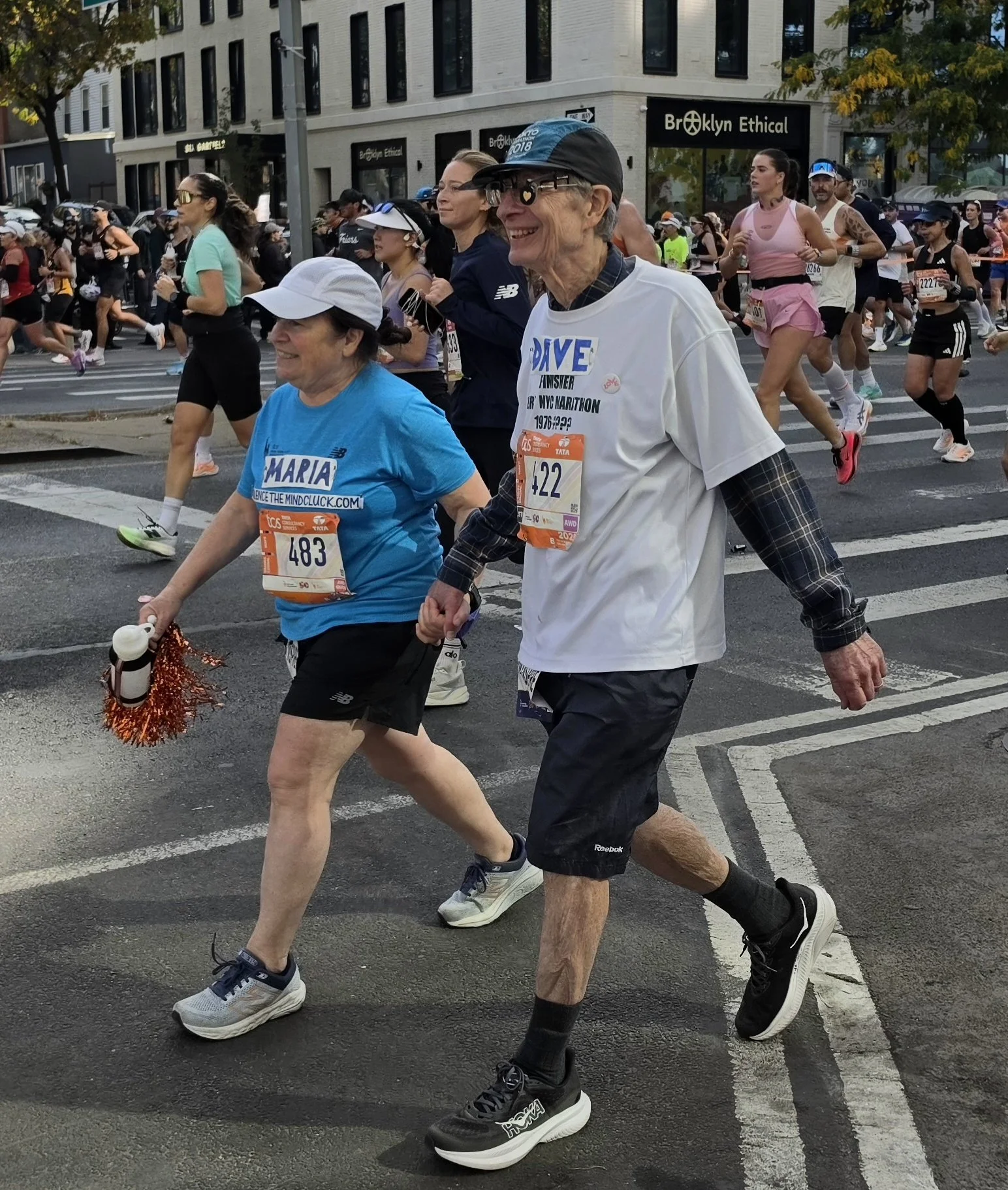
Then Dave Obelkevich walked by, holding hands with his daughter Maria, both of them smiling. Dave is 83. He has finished every five-borough New York City Marathon since the first one in 1976. On Sunday, he finished his 50th.
In 1982, he ran it in 2:40. In 2020, an aortic aneurysm nearly killed him. In 2021, he was back, walking it in seven and a half hours. Maria has gone the full distance beside him every year since.
Then the Achilles International athletes in their bright yellow shirts. A woman on two crutches. A man named Alan with a cane. A man in a hand-powered wheelchair with a guide at each side. Two blind runners, trusting their guides through 26.2 miles of New York City streets they couldn't see. One of them was running between two guides, tied to them by ropes.
Brooklyn showed up for every one of them. A troupe of Brazilian women drummers pounding away at Douglass Street, the same spot they hold every marathon. A toddler in a tiger suit stepping into the street to high-five runners. A guy in a banana costume with MICKY written on the front. A woman holding a sign that scored her boss's marathon, line by line, ending with "Raise given for great sign."
At the water stop near Dean Street, rows of volunteers in orange and white rain jackets handed out cups to strangers, one at a time, for hours. Somebody planned every one of those cups.
None of the people in yellow were going to win. All of them had decided they would finish before they ever reached the start line.
Almgren didn't win on belief alone. He's the world half marathon champion, and his legs were built over years. Marty didn't get to 90 and onto that course by wishing either.
The training gets you to the start line. The mind decides what you do once you're there.
The box isn't your industry
The box is the shape you assume your business has to take.
In 1990, three Egyptian immigrants opened a hot dog cart at 53rd and Sixth. Two years later they switched to halal food, because the city's Muslim cab drivers had nowhere to eat. For nearly 25 years it stayed a handful of carts. Today The Halal Guys have over 100 locations worldwide.
Their food didn't change. Their question did. They stopped asking how to run a better cart and started asking what this could become.
Gujarati families, many named Patel, did the same with motels. Starting in the 1970s, they bought one roadside property at a time, pooled savings with relatives, and kept going. Today members of the Asian American Hotel Owners Association own about 60 percent of the hotels in the country.
I see the same playbook in restaurants right now. Brothers, cousins, and in-laws backing each other's stores, one location after another. Trust first, then capital, then growth.
Every tradition at your table knows this
The Qur'an teaches that God does not change the condition of a people until they change what is within themselves (13:11). The first hadith in Sahih al-Bukhari says actions are judged by their intentions.
Muslims call it niyyah. Hindus call it sankalpa. Same principle: decide what you are reaching for before you reach.
Intention is a business tool
1. Start at the end. Picture your business five years out, then work backwards.
Instead of opening a restaurant and hoping for a hit, find what's missing first. A halal dessert nobody makes well. A drink your community can't find. A sauce people would buy by the bottle. Then build the restaurant to be its home.
Customers rarely know what to ask for. They ask for a cheaper version of what already exists. So don't ask. Create it, test it in the stores you have, and let their orders answer. If they come back, you've found your void. If they don't, it cost you a few weeks, not a new concept.
Vision is your job. The verdict is theirs.
2. Be curious before you're certain. When you hear yourself say "that's never happened before," ask one question: is that a reason, or a memory?
3. Ask the starting-over question. If you built this business today, with today's tools, would you build it the way it runs now? Most owners never ask, because their business was built for a world that no longer exists.
4. Different results need different inputs. A new manager, a new advisor, a new tool, a new way of reading your numbers. Same people, same habits, and same information will reliably produce the same store.
You've already done the hardest version
I grew up in upstate New York, working a bread route. Along the way, a car crash threw me through a windshield and nearly killed me. Two back surgeries. Two shoulder surgeries. More after that.
Nobody looked at that guy and saw one of the top foodservice salespeople in the country. I didn't either.
Who thought that would happen?
Many operators I work with have their own version of that story. You crossed an ocean, learned a new language, and built a business in one of the hardest restaurant markets in the world. Someone probably told you that's never happened before.
Money, time, and permits are real limits. But imagination is the first one, and most of us hit it long before we reach the others.
So the next time someone tells you that's never happened before, give them the honest answer:
Not yet.
Sources
Epoch AI: AI math capabilities could be jagged for a long time (Daniel Litt)
Live Science: OpenAI’s AI model solved an 80-year-old math problem, and mathematicians verified it
Franchising.com: The Halal Guys ranks #1 on Restaurant Business Future 50
Marathon Handbook: The only runner to finish every five-borough NYC Marathon
NY1: 90-year-old runner laces up for the New York City Marathon